
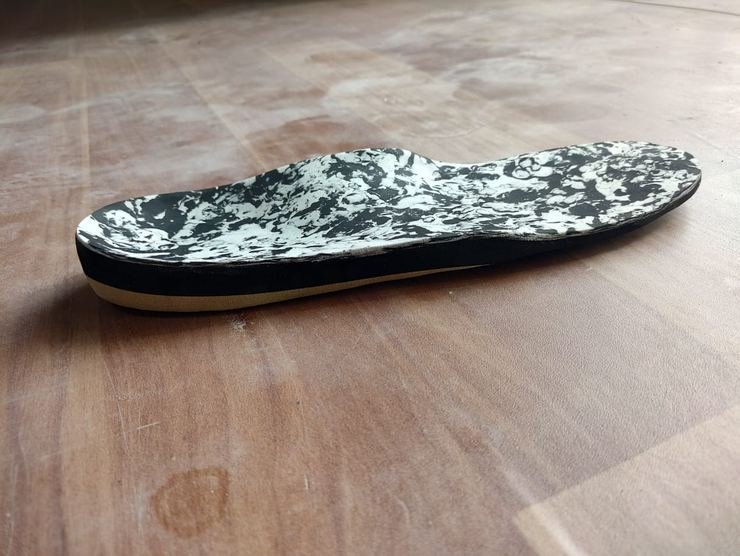
Custom insoles and orthotics do not fail dramatically. They flatten, compress and lose their shape gradually, and because the change happens slowly you adapt to it without noticing. People usually come in because the pain they originally solved has quietly returned — often months after the device stopped doing its job.
This is the check worth doing twice a year, and it takes two minutes.
The problem with waiting until it looks worn
An insole works by holding a shape under load. The materials that do that — EVA, foam, cork composites — compress permanently over time. The top cover may still look perfectly respectable while the structure underneath has lost a significant part of its support.
Appearance is the least reliable indicator. A device that looks fine can be finished, and one that looks grubby can still be working. What matters is whether it still holds its shape under your weight.
Signs it is time
- The symptoms are back. The clearest sign of all. If the heel pain, arch ache or forefoot discomfort your insoles solved has returned, suspect the insoles before concluding your condition has worsened.
- Visible flattening of the arch area compared with the opposite side or a newer pair.
- Thinning or compression under the heel or forefoot — the areas that take most load.
- The shape no longer matches your foot when you hold it against your sole.
- New rubbing, blisters or callus where there were none.
- Cracks or splits in the shell, or a top cover lifting at the edges.
- Uneven wear — one considerably more worn than the other.
- They slide in the shoe or no longer sit flat.
Roughly how long things last
These are general ranges, not a guarantee. Someone on their feet twelve hours a day on concrete will get through a pair far faster than someone who works at a desk.
| Device | Typical range | What shortens it most |
|---|---|---|
| Custom moulded insoles | Around 1–3 years | Body weight, hours on your feet, hard surfaces |
| Ready-made insoles | Around 6–12 months | Softer materials compress faster |
| Diabetic footwear | Review at least annually | Foot shape changes; cushioning compresses |
| Diabetic insoles | Often replaced more often than the shoes | They do the pressure-relieving work |
| Offloading devices | As clinically directed | Reassessed whenever the at-risk area changes |
| Children’s insoles and orthoses | Growth, not time | Often more than once a year |
The shoes matter too. Orthotics sit inside footwear, and a supportive insole in a shoe whose midsole has collapsed will not perform. See how to choose orthopedic shoes.
Diabetic footwear and insoles: a stricter rule
If you have diabetes with reduced sensation, the usual signal to replace something — discomfort — may not reach you. That changes the rule from “replace it when it feels wrong” to “replace it on schedule and inspect it regularly”.
- Check insoles and the inside of shoes weekly for compression, cracks, rough patches or anything that has worked loose.
- Look for new callus — it marks a pressure point, and a pressure point means the device is no longer relieving that area.
- Have footwear and insoles reviewed at least yearly, and sooner if your foot shape changes.
- Do not wait for pain to tell you. It may not.
If you find a wound, a blister, redness that does not settle, or a warm swollen area, see a clinician promptly. That is not a footwear question. See foot care and diabetic solutions and diabetic foot orthotics.
A two-minute check
- Take both insoles out and put them side by side. Is one more flattened?
- Press your thumb into the arch of each. Does it spring back, or stay compressed?
- Hold one against the sole of your foot. Does the shape still match?
- Run a finger over the surface. Any cracks, splits, lifting edges or rough patches?
- Look inside the shoe. Is the lining worn through anywhere, and is the heel counter still firm?
- Think back — are any of the symptoms that led you to get them creeping back?
Two or more yes answers is worth a review. Take the old pair with you; wear patterns tell us how you load your feet and inform the replacement.
Making them last
- Rotate between two pairs of shoes where you can. Materials recover with time out of use.
- Let them dry fully — take insoles out at the end of the day. Never dry them on a heater or in direct sun; heat destroys the materials.
- Wipe rather than soak. Immersion lifts top covers and degrades adhesives.
- Keep them in the shoes they were fitted for. Moving an insole between shoes of different depth and heel height changes how it works.
- Replace the shoes too. New insoles in collapsed shoes solve only half the problem.
If you are not sure whether yours are finished, send a photograph of them next to each other on WhatsApp. We can usually tell, and if they are fine we will say so.
Frequently asked questions
How long do custom orthotic insoles last?
Typically around one to three years, though this varies widely with body weight, hours on your feet and the surfaces you walk on. Someone standing all day on concrete will replace them considerably sooner than a desk worker.
How do I know if my insoles have stopped working?
The most reliable sign is the return of the symptoms they were made to address. Also check for flattening of the arch, compression under the heel and forefoot, cracks, and new rubbing or callus.
Can worn insoles cause new problems?
They can stop relieving the areas they were made to relieve, which may allow old symptoms to return or new pressure points to develop. For someone with diabetes and reduced sensation that matters more, because the warning signs may not be felt.
Should I replace my diabetic shoes and insoles at the same time?
Not necessarily. Insoles usually need replacing more often than the shoes, because they do the pressure-relieving work. Both should be reviewed at least annually, and sooner if your foot shape changes.
Can insoles be refurbished instead of replaced?
Sometimes a top cover can be replaced or a device adjusted, which is worth asking about. Once the structural layer has compressed, though, recovering it is not possible and a new device is needed.
Should I bring my old insoles to the appointment?
Yes, always. The wear pattern shows how you load your feet and what the previous device did and did not manage, which directly informs the replacement.
Not sure if yours are finished?
Send a photograph of both insoles side by side on WhatsApp. We can usually tell from the wear pattern — and if they are still fine, we will tell you that.
Message us on WhatsAppContact & directions