
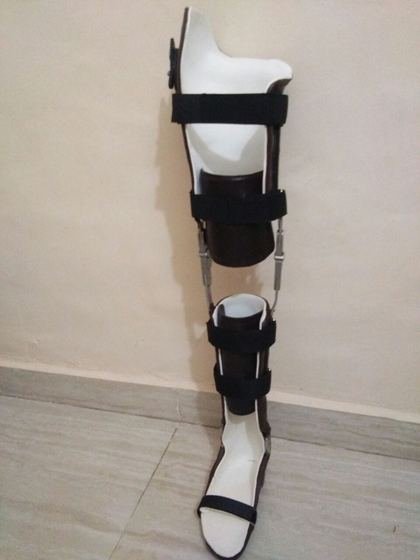
If you have been told you need a brace and handed an abbreviation, the naming system is genuinely logical once you see it: each letter is a joint the brace crosses, listed from the top down.
AFO — Ankle Foot Orthosis. KAFO — Knee Ankle Foot Orthosis. HKAFO adds the hip. More letters means more joints controlled, which means more support and also more bulk.
The difference in one line
An AFO controls the ankle and foot. A KAFO controls the knee as well. The decision between them comes down to one question: can your knee be trusted to hold your weight?
What an AFO does
An ankle foot orthosis crosses the ankle and ends below the knee. It is the most commonly prescribed lower-limb orthosis, and it does one or more of the following:
- Holds the foot up during swing. This is the classic drop foot application — without it the toes catch on the floor.
- Controls the ankle at heel strike so the foot does not slap down.
- Limits unwanted movement inward or outward, improving stability on uneven ground.
- Holds alignment to prevent a deformity worsening.
- Protects after injury or surgery.
AFOs range from thin flexible polypropylene through to rigid designs and carbon fibre. A key point: an AFO can indirectly affect the knee. By controlling where the ankle sits, a well-set AFO changes the forces passing through the knee, and for some people that is enough to make the knee feel stable without bracing it directly.
What a KAFO does
A knee ankle foot orthosis extends up the thigh and adds a mechanical knee joint. It is prescribed when the knee itself cannot be relied on — typically because the muscles that extend it are too weak to stop it buckling under load, or because the joint is unstable.
The knee joint in a KAFO can be:
- Locked in extension — the leg stays straight while walking and is unlocked to sit. Maximum security, altered gait.
- Free — the knee bends normally, with the brace providing alignment control rather than stability.
- Stance control — the knee is supported when weight goes through it and free to bend during swing. Closer to natural walking where the user can manage it.
In India the most familiar KAFO application is post-polio bracing — see polio calipers and KAFO leg braces, which covers that use in detail.
Side by side
| AFO | KAFO | |
|---|---|---|
| Joints crossed | Ankle and foot | Knee, ankle and foot |
| Extends to | Just below the knee | Upper thigh |
| Main purpose | Ankle control, foot clearance | Knee stability under load |
| Prescribed when | Ankle control is the problem and the knee is reliable | The knee buckles or cannot be trusted |
| Weight and bulk | Lighter, easier under clothing | Heavier and more visible |
| Footwear | Needs shoes with room and a removable insole | Same, plus clothing that accommodates the thigh section |
| Sitting | Straightforward | Depends on the knee joint; a locked knee must be released |
| Typical reasons | Drop foot, stroke, nerve injury, CP, post-surgical control | Quadriceps weakness, post-polio, significant instability |
Why one is chosen over the other
This is a clinical assessment, not a preference. The orthotist and the referring clinician are looking at:
- Muscle strength, particularly the quadriceps. Can they stop the knee collapsing when you load it?
- Knee stability — does the knee hyperextend or give way?
- Whether deformity is correctable or fixed.
- How and where you walk, and for how long.
- What you can manage — a brace that is too complex to put on correctly will not be worn.
The general principle is to brace the least that will do the job. Every additional joint controlled adds weight, bulk and effort. If an AFO achieves what is needed, that is better than a KAFO — not a compromise.
When neither is enough
If hip control is also required, the next step up is an HKAFO, which extends to a pelvic section. These are considerably more demanding to use and are prescribed selectively.
Living with each
- Footwear. Both need shoes with depth and a removable insole. Buy shoes with the brace on. See how to choose orthopedic shoes.
- Skin. Check daily for red marks. Redness that does not fade within about twenty minutes means the fit needs attention — that is a fitting problem, not something to tolerate.
- Socks. Wear a sock under any brace. Skin against plastic or metal will not end well.
- Build up wearing time as advised rather than going straight to full days.
- Children grow out of braces. Expect regular refits — see pediatric orthotics.
For the wider picture, what is an orthosis covers the full range of devices and how they are classified.
Frequently asked questions
What is the difference between an AFO and a KAFO?
An AFO crosses the ankle and ends below the knee, controlling the ankle and foot. A KAFO extends up the thigh and adds a knee joint, so it also controls the knee. A KAFO is used when the knee itself cannot be relied on to hold weight.
Can an AFO help knee stability?
Sometimes, indirectly. By controlling where the ankle sits, an AFO changes the forces passing through the knee, and for some people that is enough to make the knee feel stable without bracing it directly. Whether it is sufficient is an assessment decision.
Is a KAFO better than an AFO?
No — it controls more, which is not the same as better. Every joint a brace crosses adds weight, bulk and effort. The aim is to brace the least that does the job.
Can I walk normally in a KAFO?
Gait changes, particularly with a locked knee, because the leg stays straight through the step. Stance control knee joints allow a more natural pattern for users who can manage them.
How long does a brace last?
For adults, typically a few years depending on use, though straps, padding and joints wear sooner and are replaceable. Children outgrow braces and need refitting regularly, often more than once a year.
Who decides which brace I need?
Your referring clinician and the orthotist assessing you, based on muscle strength, joint stability and how you walk. It is not a choice made from a catalogue.
Not sure which brace you have been prescribed?
Send us a photograph of the prescription or the brace itself and we will tell you what it is and what it does. No charge for that conversation.
Message us on WhatsAppContact & directions